Why customers repeat themselves after a handover
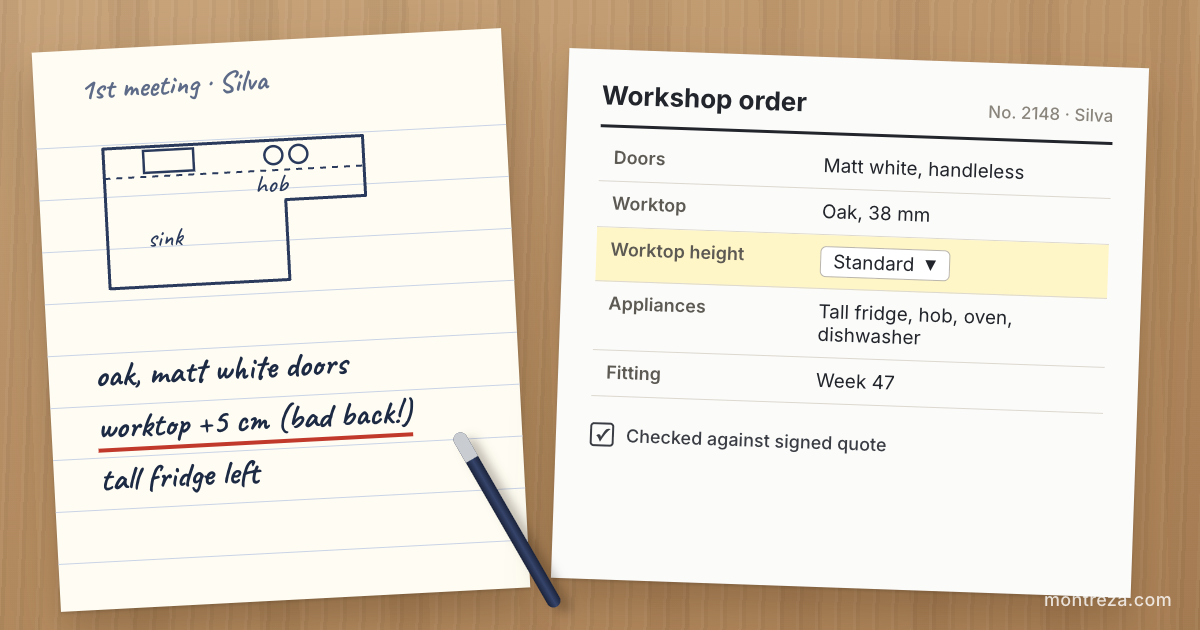
A couple orders a new kitchen. In the first meeting the husband mentions, almost in passing, that he is tall and has a bad back. Could the worktop be a little higher than usual? The designer writes “worktop +5 cm (bad back!)” in her notebook. Everyone nods. It feels handled.
Six weeks later the fitters arrive. The worktop goes in at standard height.
Nobody was careless. So let’s follow that one sentence and see where it went.
Where the sentence went
The designer’s notebook. Written down, in her words, next to the sketch of the layout. So far, so good.
The quote. The quote lists cabinets, appliances, worktop material and colour. Height isn’t a line on a quote, because it doesn’t change the price. So it isn’t there. The customer signs a document that says nothing about it.
The workshop order. This form does have a height field. It comes pre-filled with the standard value, because most customers want the standard. The designer fills the order from the signed quote, not from her notebook. The field already has a value, so nothing makes her stop.
The fitters’ job sheet. Printed from the order. Standard height. The fitters do exactly what it says.
The sentence didn’t vanish in one place. It fell out at the first handover, where the next document had no line for it. Then it was buried at the second, where a default value made the gap look filled.
What one lost sentence costs
On the day, the fitters can’t fix it on the spot. Raising the worktop means taking it off, new legs or plinths, and coming back. Add parts, a second visit and a week or two of delay, plus a fitting slot another customer was waiting for.
The bigger cost is quieter. From now on the husband repeats everything to everyone. He phones the office to confirm the tap he chose. He tells the fitter where the sockets go, though the plan already shows them. He asks for every change in writing. Each of those calls lands on someone who has to stop, find the file and check.
He isn’t being difficult. He has learned that telling you once isn’t enough. That is what “customers repeat themselves” really means. It isn’t their habit. It’s a conclusion they reached about you, and it usually started with one dropped detail.
The same path in other businesses
The kitchen just makes it easy to see. The same path runs through:
- An event venue. The client says two guests use wheelchairs. The floor plan is printed from the booking form, which has a field for the number of guests and none for access.
- A travel agency. The client asks for twin beds, because two friends are travelling together. The hotel request is copied from a template that defaults to a double.
- A dental clinic. A patient tells reception they get anxious and need longer appointments. The booking system offers the standard slot, and the note stays in the phone call.
Each time, the requirement was said, heard and written down once. It was lost where it had to move into the next document.
A test you can run this week
- Pick three jobs from the last two months that needed a second visit, a correction or an apology.
- For each, find the first place the customer’s requirement was written: a notebook, an email, a WhatsApp message.
- Follow it document by document: quote, order, job sheet, calendar entry. Mark the last place it still appears.
- At the next document, ask two questions: was there a line for it? Was that line already filled in with a standard value?
Most lost requirements turn up at one of those two spots: a document with nowhere to put “what the customer told us”, or a field whose default nobody questions.
Two small changes aim straight at them:
- Every document that passes work on gets one line: “Customer said:”, in the customer’s own words, copied forward unchanged, never shortened.
- Choices that belong to the customer start empty. Height, colour, access, bed type, appointment length. An empty field makes someone ask. A default never does.
Neither needs new software. If you later automate part of a handover, build both in from the start, because a system copies a default faster than any person.
Which requirement did a customer have to tell you twice last month?