Before AI answers your customers, check what it will read
In February 2024 a Canadian tribunal ordered Air Canada to refund part of a customer’s fare. The airline’s website chatbot had told him he could claim a bereavement discount up to 90 days after buying his ticket. The airline’s own policy page said the opposite, and the chatbot had even linked to it. Air Canada argued that the chatbot was separate from the airline and that the customer should have checked the page. The tribunal disagreed: a business is responsible for everything on its website, and that includes its chatbot (Moffatt v. Air Canada, 2024 BCCRT 149).
The amount was small, about 650 Canadian dollars. The lesson isn’t. Unless it is built to check, an AI assistant usually won’t flag that two of your sources disagree. It tends to pick one, writes it confidently, and the customer believes it.
Most small businesses already have conflicting answers, with or without AI. The website says one thing, a WhatsApp reply from last month says another, and a colleague remembers a third. Give an assistant all three and it may repeat any of them.
Three mistakes we saw in a real build
We built an Instagram assistant for a children’s camp. When we reviewed its first 126 replies across 53 conversations, three mistakes taught us the most. None of them came from a weak AI model. All three came from what the assistant was given to read, or from what it was allowed to promise.
1. If it isn’t written down, it doesn’t exist. A parent mentioned the 5% discount for bringing a friend. The assistant replied that there was no such discount. The discount was real; it just wasn’t in the assistant’s information. An AI tends to answer “no” here rather than “I’m not sure”, and research published in September 2025 explains why: the way these models are trained and scored rewards a confident guess over admitting uncertainty (Kalai and others, “Why Language Models Hallucinate”).
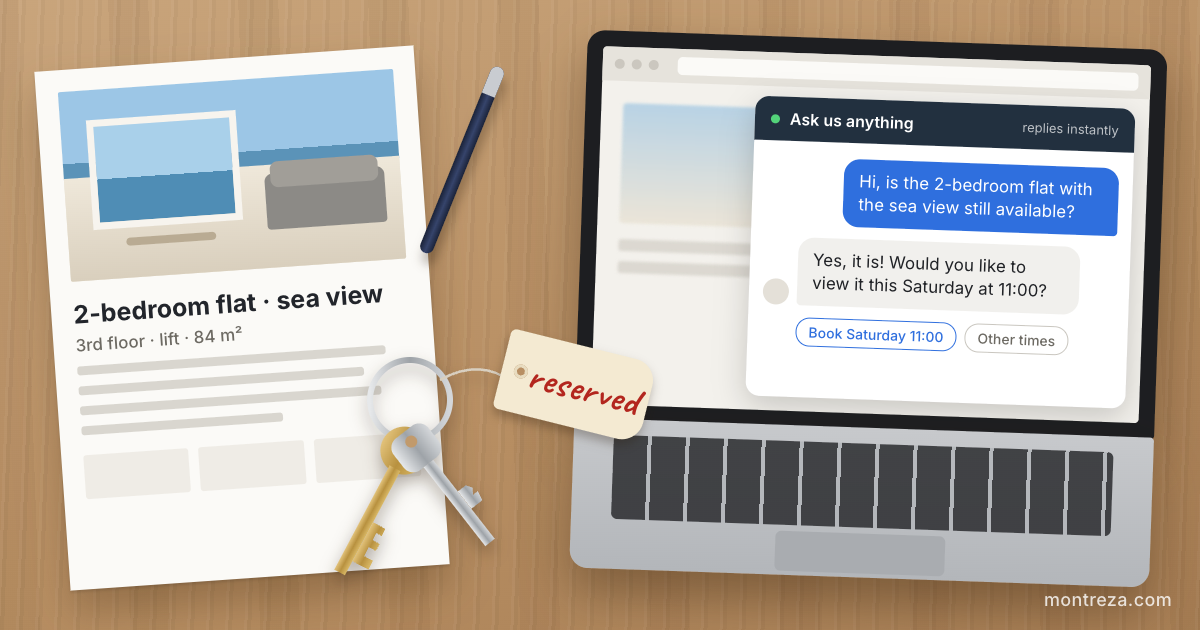
2. Describing something is not the same as having it free. A parent asked which rooms were free for one session. The assistant said both room types were. It was reading a description of the rooms the camp has, not a list of what was still free. An estate agency faces the same trap: the listing says “two-bedroom flat, sea view”, but the flat was reserved yesterday. An assistant reading the listings will happily offer a viewing.
3. Promising what it can’t do. The assistant wrote “I’ll check this for you.” It had no way to come back to anyone. The fix was a rule: when it can’t answer, it asks for a name and phone number so a person can call.
All three were fixed by changing what the assistant reads and what it may promise. None needed a smarter model.
A test you can run before any AI tool
- Write down the ten questions customers ask you most. For an estate agency: Is it still available? Can we see it on Saturday? Is the price negotiable? Is the reservation deposit refundable? What do we need to buy? (In Portugal every buyer needs a tax number, the NIF.)
- Find the answer to each in three places: your website, the last message you sent about it, and one colleague asked in writing.
- Mark each row same, different or missing.
- For every row marked different, agree one answer. Add today’s date and the name of the person who updates it.
- Mark every answer as fixed or live. A fixed fact is what the flat has. A live fact is whether it’s free today. Live facts must come from the system your team keeps up to date, never from a web page or a document.
Your missing rows are where an assistant would deny a discount that exists. Your live rows are where it would offer a room, or a flat, that’s already gone.
What the result tells you
If your list is short and rarely changes, you may not need an AI tool for this. A shared page that everyone uses can be enough.
If it’s long, changes every week, and questions arrive through several channels and languages, an assistant can take real work off your team. Even then, this list comes first. Without it, the assistant gives your customers your old answers, faster.
Which answer on your list would you least want a customer to get wrong?